
 EN
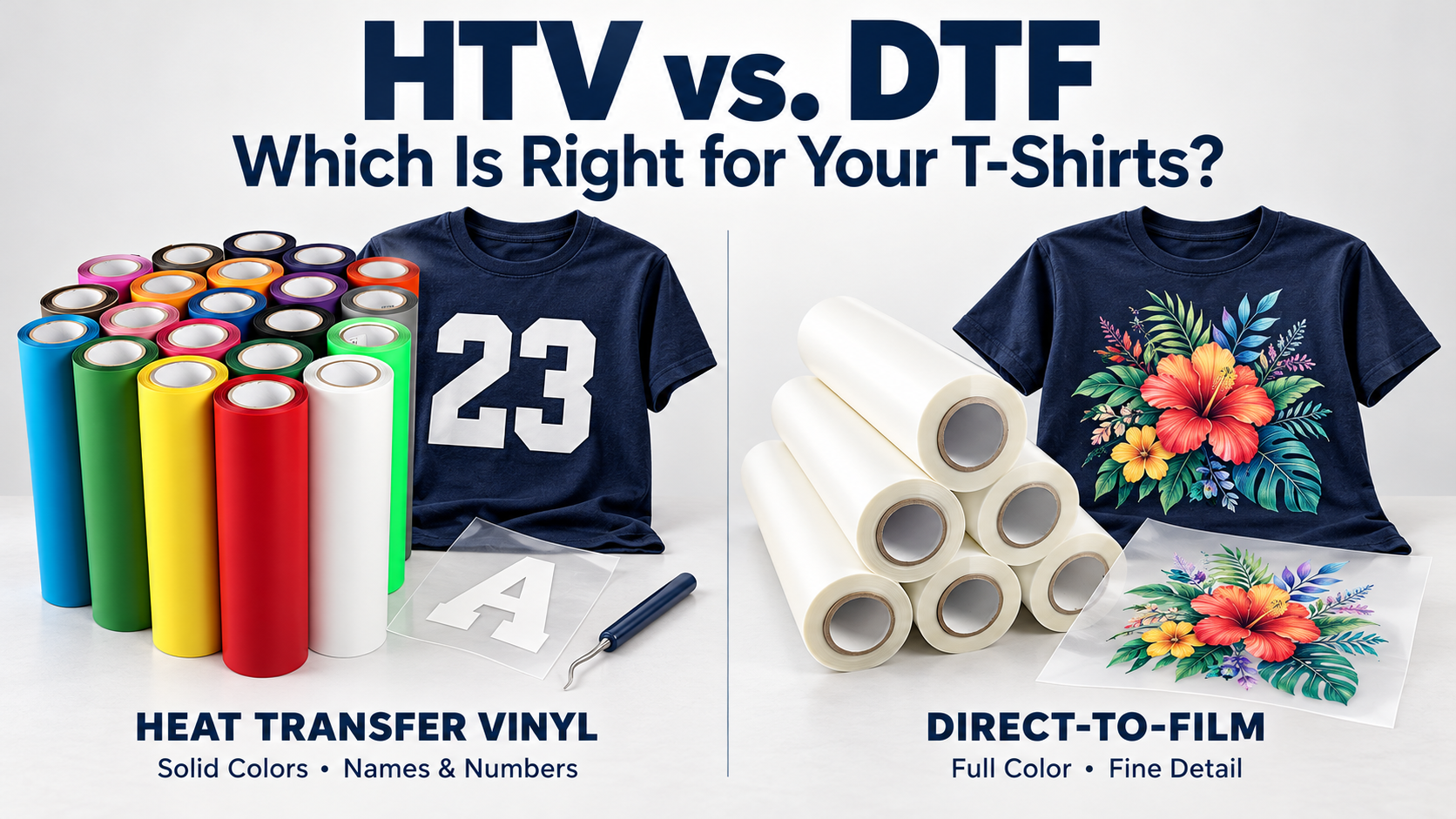
Heat transfer vinyl (HTV) and DTF (direct-to-film) both put a design on a t-shirt with heat, but they make that design in opposite ways. HTV cuts a colored film and presses it on; DTF prints a full-color image onto a film, coats it with adhesive powder, and presses it on. The better method depends on your order size, how detailed the artwork is, and what fabric you are printing.
This guide walks through how each process works, where each one saves money, and which t-shirts each method handles well.
What heat transfer vinyl (HTV) is
HTV is a thin colored or textured film with a heat-activated adhesive on the back. You create the artwork on a computer, send it to a vinyl plotter, and the machine cuts the shape out of the roll. After cutting, you peel away the surrounding material by hand — a step called weeding — and press the remaining design onto the shirt with a heat press.
Because each color is a separate physical layer, HTV suits designs with solid blocks of color, simple text, and clean shapes. Metallic, glitter, puff, and reflective finishes are all available as different film types rather than as print effects.
What DTF (direct-to-film) is
DTF prints the artwork directly onto a PET film using a dedicated printer loaded with CMYK and white ink. The printed film is then covered with hot-melt adhesive powder, cured with heat, and pressed onto the garment. The film is peeled away, leaving the printed image on the fabric.
Because the design is printed rather than cut, DTF handles full-color photographs, gradients, and fine detail in a single step. There is no weeding, and the same file can produce one shirt or one thousand with no change to the setup.
How the two processes compare, step by step
HTV workflow 1. Design the artwork in vector format. 2. Cut the film on a vinyl plotter. 3. Weed the excess material by hand. 4. Heat press the design onto the shirt (typically 150–160°C for 10–15 seconds, depending on the film).
DTF workflow 1. Print the artwork onto PET film with CMYK + white ink. 2. Apply hot-melt powder evenly across the print. 3. Cure the powder with heat (around 120–155°C). 4. Heat press the film onto the shirt, then peel.
The extra manual step in HTV is weeding; the extra step in DTF is powdering and curing. Both end at the same place — a heat press.
Side-by-side comparison
| Factor | HTV | DTF |
|---|---|---|
| Setup before printing | Plotter cutting + weeding | Printer + powder shaker + curing |
| Color capability | One color per layer | Full color, photos, gradients |
| Ideal design type | Solid shapes, text, logos | Detailed, photographic, multi-color |
| Manual labor per piece | Weeding (scales with complexity) | Minimal after setup |
| Minimum order | 1 piece | 1 piece |
| Fabric range | Cotton, polyester blends, some synthetics | Cotton, polyester, nylon, leather, blends |
| Feel on fabric | Raised layer | Thin, closer to direct print |
| Equipment cost | Lower (plotter + press) | Higher (printer + shaker + press) |
When HTV is the better choice
Heat transfer vinyl works well for teams, events, and small brands that print recurring simple designs — names and numbers on jerseys, shop logos on tote bags, short runs of slogan tees. If your artwork is a few solid colors and you already own a plotter, the per-piece cost stays low and the finish is durable. Specialty looks such as metallic, glitter, and puff are also easier to reach with film than with print.
When DTF is the better choice
DTF suits orders with full-color or photographic artwork, or any run where the design changes frequently. Because there is no weeding and no screen or plate to prepare, a single printer can move from one design to the next without setup. For print-on-demand shops and mixed small orders, this flexibility is the main advantage. DTF also covers a wider fabric range, including nylon and leather, which some vinyl films do not bond to as reliably.
Cost and order volume: the deciding factor
Neither method has a meaningful minimum order — both can produce a single shirt. The difference shows up in labor and equipment.
HTV keeps variable cost low for simple designs, but weeding time grows with the number of colors and the detail of the cut. Past a certain volume, that manual step becomes the bottleneck. DTF moves the work into the printer and powder shaker, so per-piece labor stays roughly flat as volume rises. A 60 cm DTF printer with four printheads, for example, runs at about 20 m²/h in 6-pass mode — enough for a steady daily output of finished garments.
In practice, many shops run both: HTV for quick solid-color jobs they can cut in-house, and DTF for anything detailed or color-heavy.
Fabric and design considerations
Cotton and common blends accept both methods. Polyester works with both, though dye-sublimation-prone fabrics can show bleed-through under heat — DTF films rated for anti-sublimation address this. For stretchy or performance wear, choose a film or powder formulated for high elasticity so the print survives washing and movement.
Design detail is the other hinge. A two-color logo is faster and cheaper as HTV. A photo of a band, a gradient, or small text in many colors belongs to DTF.
Workspace, equipment, and skills
HTV needs a vinyl plotter and a heat press, plus bench space for weeding. The skill is in clean weeding and correct press settings; mistakes show as lifted edges or uneven pressure. DTF needs a printer, powder shaker, and curing, and the powder and curing steps release fumes, so ventilation or a fume purifier is part of the setup. DTF operators mainly manage the file and machine, with less hands-on cutting.
Frequently asked questions
Can HTV and DTF be used on the same shirt? Yes. It is common to press a DTF photo and an HTV name or number onto one garment, layering the two for different effects.
Which lasts longer in the wash? Both hold up well when applied at the correct temperature, pressure, and time. HTV forms a bonded layer; DTF sits as a printed film. Following the film or powder's recommended press settings matters more than the method choice.
Do I need different equipment for each? Partly. Both need a heat press. HTV adds a vinyl plotter; DTF adds a DTF printer, a powder shaker, and a curing step. A shop starting fresh should budget accordingly.
Is one better for small orders? Both handle one-off orders. HTV wins on equipment cost for simple art; DTF wins on speed when the art is complex or changes often.
How Kenteer supports both workflows
Kenteer (Xiamen) Digital Technology Co., Ltd. has manufactured heat transfer and digital printing materials since 1996. The company runs a 110,000 m² factory with more than 300 staff and four R&D teams, and holds OEKO-Tex, CE, RoHS, REACH, SGS, and RSL certifications.
Its product range covers both methods. On the HTV side, the Q-series heat transfer vinyl includes finishes such as Q4-2 Soft Metallic, Q2-5 Puff Glitter, and Q6-2, with a combined HTV capacity of about 200,000 m² per month. On the DTF side, the line spans 30 cm (A3), A2, 60 cm, and 90 cm printers with two to six printheads, plus DTF film, powder, ink, and powder shakers, with DTF film capacity around 2,000,000 m² per month.
Choosing the right method for your t-shirts
Start with the artwork and the volume. Solid-color, low-detail designs in steady repeats favor heat transfer vinyl (HTV) for its low running cost and durable finish. Full-color, photographic, or frequently changing designs favor DTF for its setup-free flexibility and broader fabric compatibility.
If you are setting up a print line or comparing materials, Kenteer can supply sample rolls of HTV and DTF film so you can test both on your own fabrics. Contact the team at [email protected] to discuss specifications, certifications, and minimum order quantities for your market.