
 EN
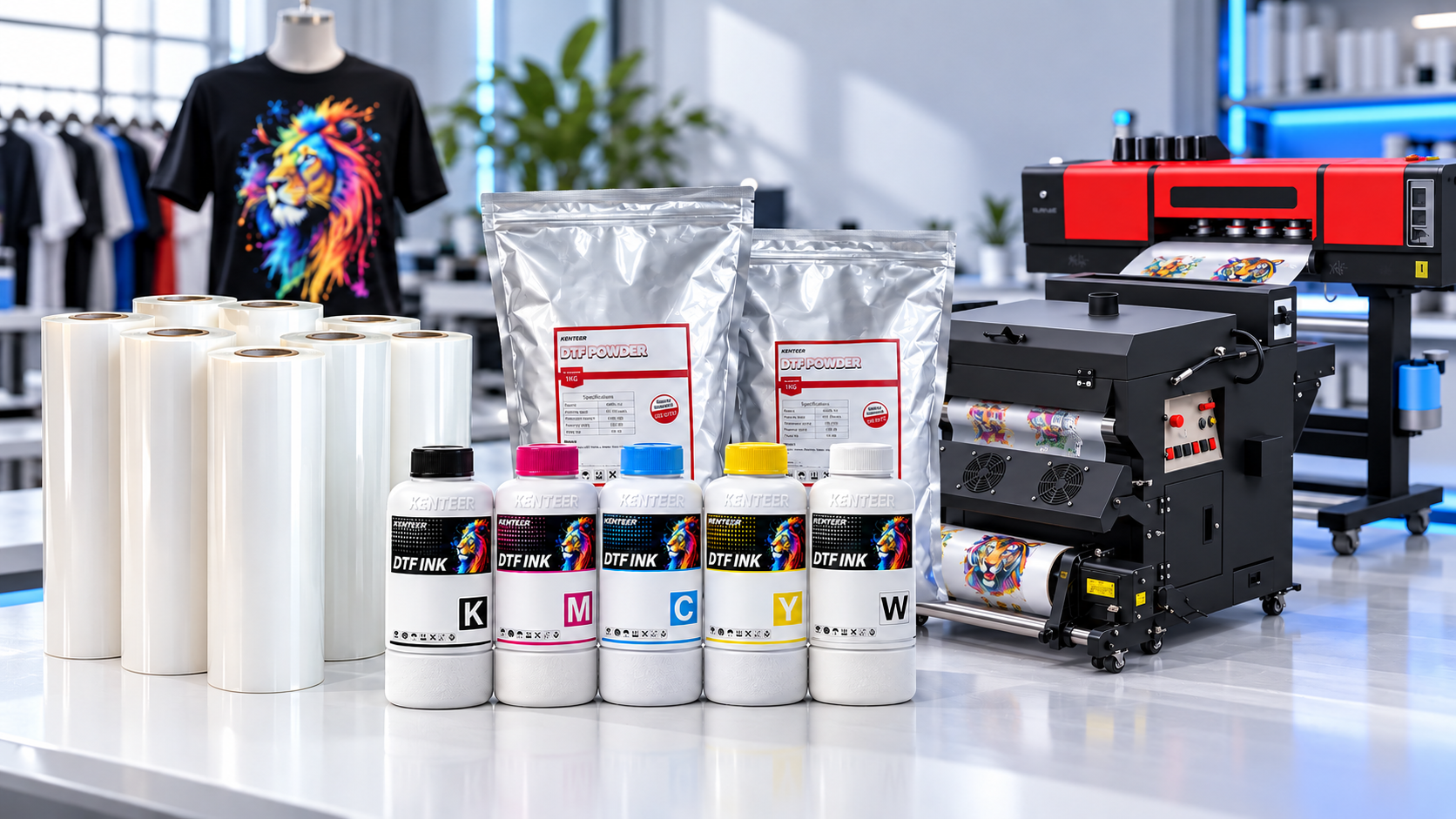
How to Choose DTF Film, Powder, and Ink: A Buyer's Guide
Direct-to-film (DTF) printing quality depends as much on the three consumables — PET film, hot-melt powder, and ink — as on the printer itself. Pick the wrong film or an unmated powder-and-ink pair and you get peeling edges, sticky finishes, dull color, or wash failure even with a good machine. This guide explains what each consumable does, the specs that matter, and the mistakes buyers make most often.
What the three DTF consumables do
A DTF print is built in layers. The PET film is the carrier: the printer lays CMYK color and white ink onto its coated surface, and that surface releases the image onto fabric during heat press. The hot-melt powder is the adhesive — it is shaken over the wet print, melted to form a glue layer, and carries the image off the film and onto the garment. The ink supplies the color, with white ink acting as an opaque base so designs show correctly on dark fabrics.
Because the three work as one system, a weak link in any one of them limits the whole result. A matched set from one supplier removes most of the guesswork.
How to choose DTF film
Film is not a single product. The variables that change how it behaves are the release coating, the peel method, and the substrate treatment.
Cold peel vs hot peel. Cold-peel film is peeled after the transfer cools; hot-peel (often called instant-peel) is removed while still warm. Hot peel speeds up production because there is no cooling wait, but it demands tighter temperature control and a film formulated for clean warm release. Cold peel is more forgiving and tends to give a slightly softer hand. Choose based on your press workflow, not on which sounds faster.
Anti-sublimation film. Polyester and poly-blends can push dye upward under heat, showing as a ghosted halo around the print. Anti-sublimation (also called anti-migration) film carries a blocking layer that stops this. If you print on polyester sportswear or sublimated blanks, this film type is not optional.
High-elasticity film. Stretchy fabrics — performance wear, spandex blends, swimwear — need a film and powder combination that stretches with the garment. A standard film can crack along fold lines after a few washes. High-elasticity film paired with a flexible powder solves this.
Width and roll quality. Film width must match the printer: 30 cm (A3), 60 cm, and 90 cm are the common widths. Beyond size, check that the release coating is even across the roll. Uneven coating shows as patchy transfer or film that tears mid-print.
| Film type | Suited for | Peel method |
|---|---|---|
| Standard cold peel | Cotton, general apparel, beginners | Cold |
| Hot / instant peel | High-volume shops, fast turnaround | Hot (warm) |
| Anti-sublimation | Polyester, sublimated blanks | Cold or hot |
| High-elasticity | Sportswear, swimwear, stretch blends | Cold or hot |
How to choose DTF powder
Powder is the glue, and its particle size and melt behavior decide how the print feels and how long it lasts.
Particle size. Fine powder gives a smoother hand and finer edge definition, which suits detailed artwork and thin lines. Coarse powder covers faster and is more forgiving on large solid areas but can feel rougher. Most shops run a medium grade that balances the two.
Melt and cure temperature. The powder is cured (melted) after shaking, typically around 120–155°C, then the finished transfer is pressed onto fabric, commonly at 150–160°C for 10–15 seconds depending on the film. If the cure is too low, the powder does not bond and washes off; too high, and it yellows or stiffens. Match the powder's rated cure range to your shaker-oven or heat-press cure step.
Wash durability. Powder is usually a thermoplastic polyurethane (TPU) hot-melt. The formulation sets how many wash cycles the print survives and how it feels against skin. If you sell finished garments, ask the supplier for wash-test data rather than trusting a claim.
Storage and handling. Powder clumps in humidity. Keep it dry and shake it evenly; uneven powdering is the most common cause of blotchy or partially adhered transfers. Some suppliers offer pre-coated film that bakes the adhesive in, removing the shaking step entirely.
How to choose DTF ink
DTF ink is pigment-based: CMYK color inks plus white ink, with the white printed first as the base layer. The white ink is where most problems start.
White ink stability. White pigment is heavy and settles. Without circulation and agitation in the printer, it clogs the printheads within days. Look for ink sold as part of a system with white-ink circulation and anti-sedimentation design — and confirm the printer you use actually runs that circulation. Ink alone cannot fix a printer that lets white settle.
Printhead compatibility. DTF inks are formulated for specific head families (commonly Epson I3200-class heads). Using ink not matched to the head risks clogging, banding, or accelerated wear. Buy ink rated for your exact printer model.
Color and fluency. Beyond not clogging, good ink gives a wide gamut and flows steadily through the damper and head. Fluency matters more than a spec-sheet claim of "vivid color" — a smooth daily run with no banding is the real test.
Certifications. Because printed garments touch skin, the ink's chemical profile matters for market access. For the EU and many retailers, REACH compliance is the baseline; OEKO-Tex, RoHS, SGS, and RSL add proof the chemistry is controlled. Ask for the actual certificates, not just a line on a datasheet.
Match film, powder, and ink as a system
The single biggest mistake is buying the cheapest item in each category from different sellers. Film, powder, and ink are tuned together — the film's release point, the powder's melt window, and the ink's adhesion are designed to meet. Mixing brands means none of the three is operating at its rated point, and the failure shows up only after pressing and washing.
A matched consumable set, even at a slightly higher unit cost, usually costs less per good transfer once you subtract wasted film, reprints, and returned garments. Suppliers that manufacture both the film and the powder and the ink can also give you one point of accountability when something goes wrong.
Certifications and compliance to check before buying
For apparel that will be worn and washed, certifications are not paperwork — they are the difference between a product you can sell and one that gets pulled from a shelf.
- OEKO-Tex — confirms the article is tested for harmful substances; expected by many brands and retailers.
- REACH — EU chemical regulation; required for the European market.
- RoHS / SGS / RSL — additional chemical-safety and restricted-substance checks.
Request current certificates named for the exact product batch, and verify they are not expired. A supplier holding all six — OEKO-Tex, CE, RoHS, REACH, SGS, and RSL — removes most compliance risk for export.
Common buying mistakes
- Chasing the lowest price per roll. Cheap film with uneven coating or powder that cures dirty wastes more than it saves.
- Ignoring the peel method. Buying hot-peel film for a workflow set up for cold peel (or vice versa) causes Film-tearing or incomplete release.
- Mixing brands. Film, powder, and ink from three suppliers rarely perform like a tuned set.
- Skipping white-ink circulation. Without it, heads clog regardless of ink quality.
- Accepting verbal certification. Insist on the named, current certificate.
Frequently asked questions
Can I mix DTF film, powder, and ink from different brands?
You can, but it is risky. Each is tuned to the others' release, melt, and adhesion points. Mixed sets cause peeling or wash failure that is hard to diagnose. A matched set from one supplier is the safer default.
What is the difference between cold peel and hot peel film?
Cold-peel film is removed after the transfer cools; hot-peel film is peeled while still warm, saving the cooling wait. Hot peel needs tighter temperature control and a film built for warm release. Cold peel is more forgiving for beginners.
Does DTF ink go bad, and how should I store it?
Like most pigment inks, DTF ink has a shelf life and the white pigment settles. Keep it sealed, at stable room temperature, away from direct sun, and rely on the printer's white-ink circulation to keep it usable during operation.
What certifications matter if I sell printed garments in the EU?
REACH is the baseline for the EU market, with OEKO-Tex, RoHS, SGS, and RSL adding proof of chemical control. Buy from a supplier that can show current certificates for the exact product.
How Kenteer supplies DTF consumables
Kenteer (Xiamen) Digital Technology Co., Ltd. has manufactured heat transfer and digital printing materials since 1996. The company runs a 110,000 m² factory with more than 300 staff and four R&D teams, and holds OEKO-Tex, CE, RoHS, REACH, SGS, and RSL certifications.
Its DTF line covers 30 cm (A3), A2, 60 cm, and 90 cm printers with two to six printheads, plus the full consumable set — film, powder, ink, and powder shakers. DTF film capacity is around 2,000,000 m² per month. The consumable range includes instant-peel, anti-sublimation, high-elasticity, washable, skin-friendly, and slow-settling film-and-powder combinations, all built to pair with white-ink circulation and anti-sedimentation printer systems.
If you are setting up or switching a DTF line, Kenteer can supply sample rolls of film, powder, and ink so you can test the matched set on your own fabrics. Contact the team at [email protected] to discuss specifications, certifications, and minimum order quantities for your market.